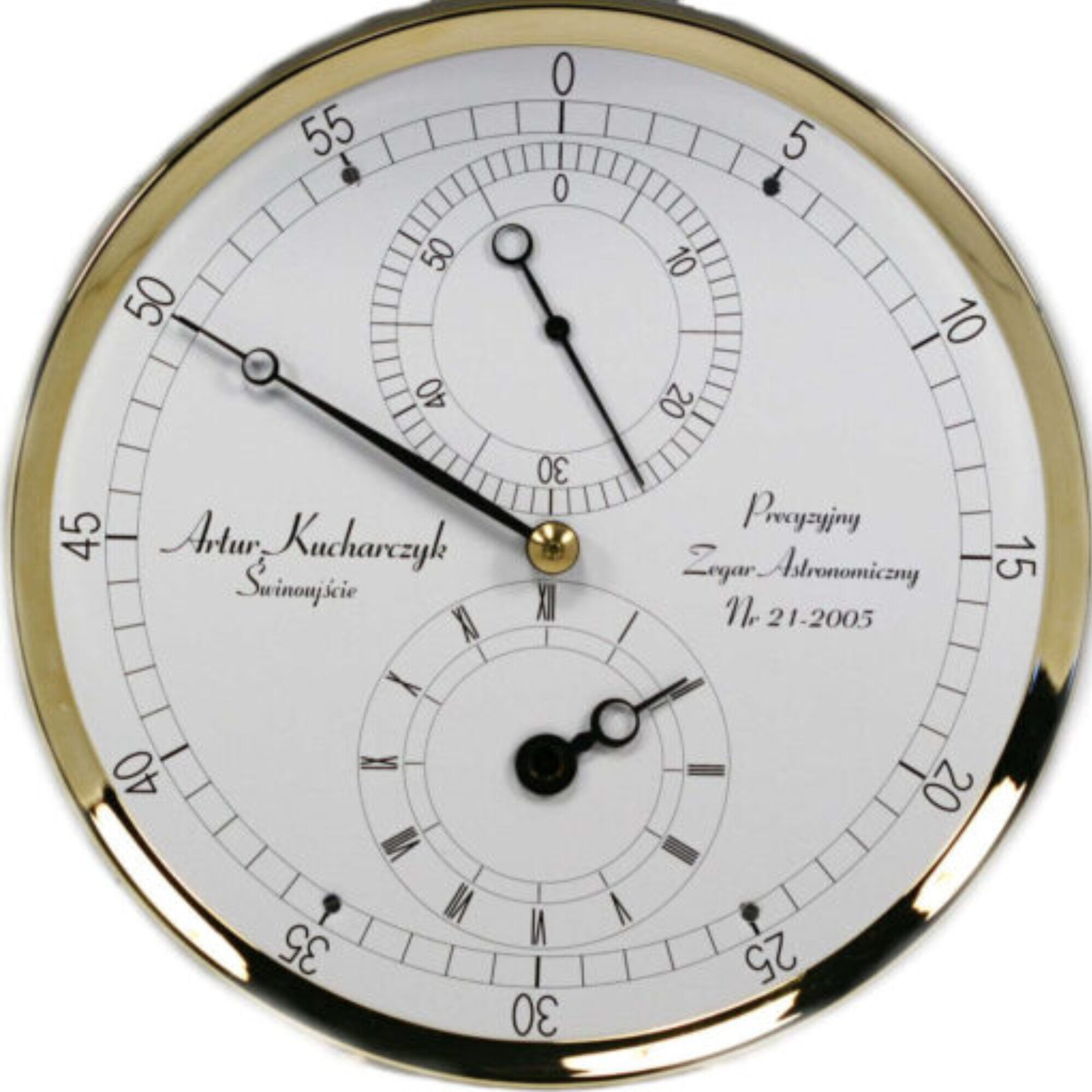
My adventure with clocks started in the late 80s when my interest in Marine Chronometers and Deck Watches began, while the interest in astronomical clocks started 15 years ago.Couple of years ago, due to the fascination I decided to create a series of 30 clocks of that type and at the same time enrich Polish tradition of clock craftsmanship which goes back to the 15th century. It is worth mentioning people who were underestimated in this field, that is Adam Adamandy Kochanski (1631-1700), and the best example: Anthony Patek, one of the co-founders of the Patek Philippe Company.In order to find yourself among the best master clockmakers, you needed to create something unusual. It took couple of years to mastermind the project. Working on the details was a difficult process since particular elements were produced in a highly complicated way and it was not easy to obtain proper materials (Ruby Jewels, Invar etc). At this point I would like to mention the creator and constructor of my clocks. There are not many people with proper knowledge and experience required to create such masterpieces but I was lucky to meet engineer, a specialist in Precise Mechanics and a retired employee of the Technical University of Szczecin. He made all the calculation for the movement gear transmission and additionally, on my special request, he also included in the construction a reserve of the clock movement so that it could work 30 days without winding up. My another request was the bearing to be made of synthetic rubies.My role was to search for and import to Poland materials unattainable in the local markets, such as invar used for the pendulum bars, and to find a specialist who could make the ruby bearings. Thanks to all the efforts, clocks were constructed using best materials in order to make them long-lasting. Galvanic gilding of most of the elements will protect them from the influence of the external factors for decades. Coordination of various processes and stages of production was also my duty. It added to the satisfaction that thanks to my idea and financial commitment a series of 30 unique clocks could be created. Clocks that are high standard timers which equal those produced by the world-known companies. Their precision in optimal conditions is one second a week which is a very good result for a mechanical device.The description of the clock was published in ‘Polski Jubiler’ (Polish Jeweler) magazine (May, 2005) please see on desciption picutre.
. They were also exhibited during the Clocks and Watches Fun Club National Meeting in Warsaw in July 2006. You can find an article scanned from ‘Chronos’ magazine here.Purchase of one of my clocks can be considered a perfect investment. I guarantee that the money spent on my product will not be wasted. Their uniqueness and the fact that there are only 30 of them will give you the joy of having an exceptional object and, what is not of less importance, something that does not lose its value in the course of time.It is not an electronic device or a mass product, more or less expensive, which value goes down at the moment of purchase so that after a year it is hard to get for them even half of the price. This clock, apart from the elementary functions, serves as an extremely beautiful and ornamental object which will decorate your living room, office or bank wall. Such clock will catch every visitor’s eye. It would be difficult to find a more representative product which will perform all those functions and meet your expectations. The uniqueness of my clocks can be seen at the first sight: beautiful box with burnished glass, long and heavy pendulum, characteristic dial, beautiful gilding elements of the mechanism, quality and luxury of every detail.I hope you will like it too. Even photos do not show the whole beauty of the clock.
Every clock fan, sooner or later, comes across astronomical clocks, the construction of which allowed to measure the time with high accuracy for over two centuries.It is worth starting with the explanation what an astronomical clock, also known as an astronomical regulator, was and the general purpose of it.Astronomical clocks were of use to the institutions for which the measurement of the exact time was of crucial importance, including: astronomical observatories (from which the clock took its name) and time measurement laboratories. What is more, astronomers in order to predict the position of a star needed not only telescopes but also as precise clocks as possible. Between the years 1875 and 1915, two clocks of this type, produced by the E. Howard Company, worked as signal clocks for The U.S. Navy Observatory. They were used to send time signals by the means of radio waves to the ships in the sea. Thanks to that, chronometers could define ship positions. E. Howard #628 regulator was sold on eBay in December 2005 for almost $ 30 000.Astronomical clocks were also used by the BBC Radio Service. Since 1924, a Dent Company clock no.2016 generated time signal which was sent by the radio.People used astronomical clocks for a long period of time – till the 60s (20th Century) since they measured time with high accuracy that mechanical clocks did not have. In order to achieve such precision, astronomical regulators had to be constructed in a careful way using the best possible materials for such mechanisms. Also conditions in which a clock worked were of high importance. That is why, clocks were usually put together in cool cellars in order not to expose them to a temperature variation which could influence their functioning. Whole construction was attached to the building foundations to exclude smallest movements cause by the external factors like traffic and noises.If all the requirements were satisfied, an astronomical clock worked in the most precise way a man could ever imagine.Each clock is unique, and rarely found on the market. Today, single astronomical clocks can be seen in museums and very few are in hands of private owners. Companies such as Riefler, Strasser & Rhode, Shortt, Dent, which have leaded in the production of astronomical clocks for the last 100 years, produced a small number of them since such clocks are for the specialist use rather than for domestic purposes.Panta rei, everything flows and changes. Constant progress replaced astronomical clocks with even more precise atomic clocks in the 60s (20th Century).Nowadays, prices of those clocks are also astronomical. Riefler regulator Tank type costs from € 50 000 to € 80 000.